Thursday, 3 November 2011

FC St. Pauli v FSV Frankfurt


It’s my party…

FC St. Pauli v FSV Frankfurt (23:10:11)

As it was a very special occasion, we'll let birthday boy and EFW regular Nick Davidson wax lyrical about a trip to see his beloved FC St. Pauli once more....

I realise there’s only a finite number of reports I can file on my visits to the Millerntor that the folks at EFW can accommodate with their usual good grace and, having written about my trip over in August for the Aachen game, I’m rapidly approaching the threshold. However, this was my 40th BIRTHDAY SPECTACULAR. And, in the best traditions of Lesley Gore, I threatened to blub like the only-child I am until Danny acquiesced and let me warble on about my ‘Special Day (TM*).’

However, there are some key differences from my regular jaunts to St Pauli… First, it wasn’t just me, it was my wife, two girls and my mate Shaun and his kids. Second, rather than my usual lightening fast visit– that’s usually curtailed by having to dash to the train station to begin the marathon haul across Europe back to St Pancras – we flew, and we were staying three days. Finally, we were going to tick off a few of the city’s tourist attractions that we’d not previously got round to seeing. So, whilst I can’t promise any new footballing insights – the Millerntor is, after all, the Millerntor and it’s always fantastic – I can offer a write up that includes: a new found obsession with TV Towers, harbour cruises, sugar-dips, early-morning runs, mid-morning drinking, excessive toilet stops and swimming with, err, dinosaurs.

The trip got off to a flying start at Luton airport (see what I did there, eh, eh?), when despite the ungodly hour we all managed to check-in, clear customs and rendez-vous with time to spare. I’m not the greatest of flyers but with the kids in the party steadying my nervous by taking bets on exactly when and where we’d crash land, the flight passed quite quickly.

We’d passed up the usual budget hotel option to live it up in a rather splendid hotel in Sternschanze, just a stones throw from one of my favourite landmarks on the Hamburg horizon, the Heinrich-Hertz-Turm or, more simply, the Fernsehturm (TV tower.) Expedia had done us proud, and the view from our room offered a fantastic view of the tower, the Millerntor and the docks beyond.


TV Tower at dawn


TV Tower close-up (I have hundreds more photos - available on request)


Big cranes: on the, err, Max 'Harbour' Kruse.

We decided to go heavy on the culture on the first day, and headed down to the Elbe to catch a lunchtime boat trip around the harbour. In our rush to get a boat we by-passed lunch and forgot to check if the tour included an English-speaking commentary. As a result, when we returned to the quayside an hour later we had some very hungry and very grumpy kids on our hands. It was officially and unanimously voted the ‘worst part of the holiday’ by the younger members of the party. The adults quite enjoyed it, though. It certainly gives you a sense of the importance of shipping to Hamburg’s history and economy. The container port is vast and highly mechanized, whilst the scale of the Blohm & Voss shipyard could also only be appreciated from the river. It was also fascinating to meander through the distinctive redbrick buildings of the warehouse district and contrast it with the shiny glass and steel of the new HafenCity. But the cultural value of such a trip can be seriously compromised if you’ve got tired and hungry kids on your hands, so as soon as we were back on dry land we headed for a café and some sustenance in the form of (Ham)burgers, chips and currywurst.

With the 3.30am start starting to catch up with us, we knocked the scheduled visit to Beatlemania on the head, settling instead for a kick-about in the park and an early tea. No drinking until dawn at the Fischmarkt for us, we were safely tucked-up in bed by 10pm.

Sunday. Matchday. Another delight of having young-ish kids is their ability to wake up early no matter what time they went to bed the previous night. Fortunately, the early start gave us a fantastic view of the sunrise over Hamburg from our hotel window and inspired me to head out for an early morning run. The bloke on reception did a double take as I emerged from the lift in shorts and a t-shirt, shunning the high-tec (and warm) surroundings of the hotel gym for a run around St Pauli. It was lovely, crisp and cold. At 7am, Budapester Straße down to the Millerntor was almost deserted, aside from the occasional worse-for-wear reveller staggering back from a Saturday night on the Reeperbahn. I stopped to catch my breath and take a few pictures of interesting bits of graffiti around the stadium, including stickers calling for the release from custody of renowned, local street artist, Oz.

Refreshed by a shower, it was nearly time for our party to split along gender lines. The girls were off to the zoo, whilst the boys were heading to the Millerntor. My eldest daughter (a veteran of FCSP’s 2010/11 opener in Freiburg) was a bit gutted to miss it, although the fact that we were standing this time would’ve made it tricky for her to see what was going on – and besides, the prospect of feeding elephants was keeping her spirits up, as was a secret pact to return to the club shop on Monday morning!

First stop was the Fanladen to collect our tickets (a delightful €11). It was good to catch up with Justus and Stefan (who I’d managed to miss on my last few trips.) Buoyed by it being my, erm, ‘Special Day’, Shaun and I decided to have a celebratory Astra. Shaun’s son joined in the fun with a bottle of Spezi, that curious mixture of orangeade and coke, favoured by many in these parts. It was 10.30am. I don’t drink a lot at the best of times, so the beer quickly went to my head, and shortly after that my bladder. I also picked up a great ‘I Just Can’t Get Enough’ t-shirt, which not only sums up how I feel about trips to the Millerntor, but also handily contains an image of my new favourite thing, the TV Tower. We then moved on to the AFM container to rendez-vous with some fellow fans from the St Pauli messageboard, but not before I’d made several trips to the portable loos outside the ground.


What Reni did next. Shaun has waited 15-years to wear that hat out in
public.


New favourite t-shirt complete with TV tower.


Man emerges from portable toilet – again!


Obligatory concrete badge shot

We elected to get into inside early to get a decent spot on the Südkurve. It’s always a pleasure to drop a few Euros into the Ultras collection tin, at least then I can feel I’ve played a very small part in supporting the amazing choreos that they put on throughout the season (and that usually I enjoy from the comfort of my computer screen.) Once in the ground we opted for more beer and currywurst. The beer was being served in ‘Denis Naki’ cups, which seemed like a good omen as he’d been sidelined by injury for much of the season, but was in contention for a start today. I spilt currywurst all down my scarf, a sure sign (as if I needed one between the regular trips to the loo) that the beer was kicking-in.

The crowd steadily built up around us. Shaun was cock-a-hoop when one of USP gave him a quick salute of recognition as he passed (probably impressed with the hair, eh, Shaunio?!) Hells Bells sent the usual shiver down the spine, as did an impressive choreo from the Nordkurve (the north terrace was all St Pauli today, as FSV Frankfurt had only brought 70 or 80 fans with them.) Not to be left out, the ‘singers-corner’ on Gegengerade was flush with shredded paper pom-poms. The sky was a beautiful pale blue, and the stands were thick with brown, red and white, it was a perfect day to watch football. Only, trouble was, I needed the loo – again. So, after a handy close-range save from the St Pauli keeper, I decided nothing much more would happen in the opening exchanges and picked my way through the crowd. Bladder emptied, I made it back to the top of the steps to see the ball looping into the FSV net. I joined in the celebrations, totally unaware of who had scored St Pauli’s opener (turned out, it was a deflected Max Kruse effort that had wrong-footed the Frankfurt keeper,) then made my way back to our spot on the terrace.

Dennis Naki, back in the team and obviously motivated by his appearance on so many plastic cups, slotted the second home to make it 2-0 at half-time. Apparently, I missed a miniature helicopter doing laps of the stadium, but what did I care, I was able to empty my lightweight bladder without missing any more goals.

The second-half was a bit of a come down. FSV got a goal back and St Pauli, as is occasionally their want, did their best to gift them an equaliser. But we held on for the win, and I held on for the entire second period without a toilet break.


Nordkurve choreo


Gegengerade confetti-storm

We hung about a bit at the end, soaking up the last of the atmosphere and the autumn sun, then made our way out of the Südkurve. However, before we met up with the girls, I had one last special request for my ‘Special Day,’ I snuck back into the ground to say goodbye to the Gegengerade. There’s a high possibility that the next time I’m back in Hamburg, I’ll be greeted by The Wave, failing that a more conservative terrace option will replace the crumbling, but much loved Gegengerade. But for now, it was one last chance to stand where, for me, it all began on the beautiful back-straight. Pictures in the bag, it was time to head back to the hotel. That’s usually where my report would end, after another intoxicating afternoon at the Millerntor. But we still had a day left.


One man confetti-storm


The fabulous painted steps of the Südkurve


Goodbye Gegengerade

On the Monday, we packed our trunks and headed off to the Festland pool to swim with dinosaurs – great big fibre-glass things that spurted warm water from their mouths and in one particular case, its, erm, bottom. The complex was massive, brand new and spotlessly clean. And owing to the fact that Hamburg’s half-term break was the week before, it was virtually empty. It also has a fabulous, heated, outdoor pool with steam rising from the water as it met the cold autumn air, giving it a slightly otherworldly feel.

One final trip to the club shop (as promised) and we were done. Another great trip to Hamburg, made more ‘special’ by the fact that I was sharing it with family and friends. I’ll be back, but this trip will always be referred to as my ‘Special Day,’ although, harbour cruise aside, everyone else enjoyed it too. Thanks to EFW for indulging me even further. Normal service will be resumed next time.

 * There were constant references to my ‘Special Day’ on this trip and, the more I think about it, I’m not entirely sure the other members of our party weren’t taking the mick. ;-)


Follow him on Twitter at @outside_left 

Wednesday, 2 November 2011

Gornik Zabrze ME v Polonia Warszawa ME & Ruch Chorzow v Legia Warszawa


The Kids are Alright

Gornik Zabrze ME 2-1 Polonia Warszawa ME (16:10:11)

A little bruised but still buoyant from his trip to Wisla Krakow, Ryan Hubbard continues on his ultimate Polish footballing adventure... 

Gornik's stadium is currently in the process of being demolished to make way for a new 33,000 seater ground; leaving three sides as a building site, and the fourth with just a 70-year old covered stand for spectators. As a Gornik supporter, one of my personal reasons for visiting this part of the world was to get to watch a game in this stadium before it was consigned to history.

Today's game was the Mloda Ekstraklasa clash between Gornik and Warsaw's second most successful club, Polonia. The Mloda Ekstraklasa is basically an Under-23's league, allowing for a couple of over-aged players in the same way as the Olympic tournament does. Although you don't get the atmosphere of a normal Ekstraklasa game, it's very relaxing to watch; and the entrance is also free, leaving extra money for a pint of Tyskie. Brilliant.

The first half saw some good football between the two young sides, but no real threat to goal; however that didn't stop the Polonia keeper from berating his back-line after every Gornik attack. The person doing the most running though, wasn't even on the pitch. Every time the ball was cleared out of play, it seemed to go over one of the fences which sectioned off the building works; leaving the two poor young ball-boys to repeatedly run around the length of the pitch to retrieve it. Sometimes there was even a second ball smashed over the fences before the first had even been recovered. The poor kids must have been knackered.


As the half-time whistle blew with the score still at nil-nil, it was time for refreshments. With the club shop closed on Sundays, we decided to wander behind the main stand in search for an elusive bottle of Pepsi (other soft drinks are also available). Once found, outside we stumbled to the sight of Aleksander Kwiek, Adam Marciniak and Michal Bemben - members of Gornik's first team - who had just returned from the previous day's game in Warsaw. With photographs saved onto the phone, we headed into the covered section of the main stand just before the second period.


"Aleksander! Photograph? Angielsko? Nie?! Dziękuje!"

The second half picked up at an extreme pace, with 18-year old striker Szymon Sobczak grabbing two goals for Gornik in the first 10 minutes. Mateusz Michalski did manage to grab a consolation for the visitors with 10 minutes left on the clock; and as the referee blew the final whistle, we got our final glimpses of the Ernesta Pohla in its current state before spilling out into Ulica Roosvelta to hunt down a taxi to Zabrze station.


Big Trouble in Little Chorzow

Ruch Chorzow 0-1 Legia Warszawa
Polish Ekstraklasa


"Trzy bilety do Chorzow Batory, proszę."

"Dziękuje."

Zabrze train station isn't the biggest or the best, but it got us to the neighbouring city of Chorzow with no real fuss. Arriving at Chorzow Batory station around 35 minutes before kick-off, and the streets were full of supporters wearing their Niebiescy (blue) scarves and shirts; making the five-minute walk to the Stadion Ruchu.

I know a little about the rivalries in Polish football; but if you are unaware, don't fret. Just take a look at this excerpt from the as-yet-unwritten "Modern Football's Guide to Polish Club Rivalries".
"Piast Gliwice and Ruch Chorzow aren't exactly the best of friends, although both have a shared dislike for Gornik Zabrze. Gornik meanwhile, have a friendship with GKS Katowice. This in turn means that GKS supporters have a rivalry with Piast and Ruch. However if this is confusing, do not worry; in this part of Poland, all clubs equally hate Legia Warszawa."
Now as you can imagine, the fans were definitely going to be fired up for this one.

Inside the ground, we were quick to purchase our official club scarves - not wanting to look like an outsider in a crowd of around 10,000 Ruch fans already in full voice before taking our positions in Sektor 9, directly behind the goal.

With the sun starting to droop slowly towards the horizon of communist tower blocks, the bitter cold quickly began to kick in. The Ultras section to our right started to become very animated, but whether this was in support of their team or simply to keep warm, I couldn't possibly tell you. Maybe it was both.


The fans from Warsaw - across the other side of the stadium to us - began to make their voices heard, with their chants of "Legia, Legia" playing as a soundtrack to their mad attempts of running from one side of the stand to another. They clearly aren't as big on health and safety in Central Europe as we are in England. They certainly aren't as fussy about allowing flagpoles into the stands as we are either, as the Ruch fans proved with their fantastic efforts towards the end of the first half.


Unfortunately for the home supporters, their displays more-or-less coincided with their team going one-nil down on the stroke of half-time. Good work down the left-hand side from Michal Zyro allowed time for a cross, and slack marking from the Ruch defence gave Daniel Ljuboja space to place his header into the bottom corner.

The second half saw both sides with chances to score; Legia hitting the post from 25 yards, and Ruch squandering numerous chances to level. And with the injury time board lifted, we headed to watch the last few minutes from the top of the stand allowing for a quick exit towards the tram stop. Despite the Niebiescy supporters willing their side on, Ruch's day was summed up with practically the last action of the game. A corner kick was drifted in, and with a straight line-of-sight towards goal, the advancing Ruch player swung his foot - only to completely miss the ball.

After waiting 15 minutes for the number 7 tram to arrive, along with several Ruch fans we made our way onto our carriage back to Katowice. After stopping to allow the Legia supporters buses past, our tram was hijacked by around 100 Ruch fanatics - intent on causing a little trouble. Singing songs about their conquerors Legia (which I can't possibly repeat on a family-friendly site such as EFW), drinking some cheap-looking Polish lager and destroying the vehicle in the process. It was only when the tram was surrounded by around 40 armed police, who then proceeded to drag the troublemakers into the Chorzow streets, was the tram finally allowed to continue its journey.

Back in Katowice, some of our remaining zlotys were spent on pizza, fries and 3 pints of Tyskie (all for less than a tenner); before heading to the Sky Bar, to reflect on our Polish Football Weekend with a view over Gorny Sląsk from 27 floors up.


Dziękuje Polska, i'm sure we'll see you again soon.


Ryan is the Editor of Modern Football and Los Revolucionarios 

Tuesday, 1 November 2011

Wisla Krakow v Jagiellonia Bialystok


Cool for Katowice

All aboard Ryan Hubbard's Polish Football Express. Fasten up as Hubbard takes us to Wisla Krakow via a whole host of other Polish football grounds on the ultimate Polish EFW....

When choosing the destination for my first ever European Football Weekend, the decision-making process lasted for all of around 4 seconds.

"Lads, how about a jaunt to Poland this October? A handful of games, even more stadia and ridiculously cheap beers?"

"No problem Ryan!"

"Good. Then we're off to Katowice!"

Katowice is in the south of the country, not too far from the border with the Czech Republic. The city is the capital of the Upper Silesian Metropolitan area (Gorny Sląsk) - Poland's equivalent of Manchester and its surrounding towns. And with six clubs in the top two-flights within a 30-minute train ride, and the city of Krakow just over an hour away by bus, the chances are it was a great place to get a couple of games in.

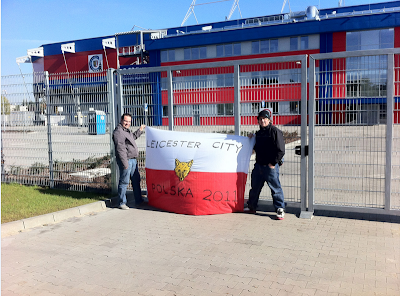
Within a couple of hours in the country, Gareth, Bridgie (my fellow EFWers) and myself had our first stadium already tucked under the belt. A trip on the tram and a £3 taxi ride brought us outside of the Stadion Ruchu, home of 14-time champions of Poland Ruch Chorzow, to pick up fan-cards and tickets for their game on Sunday.


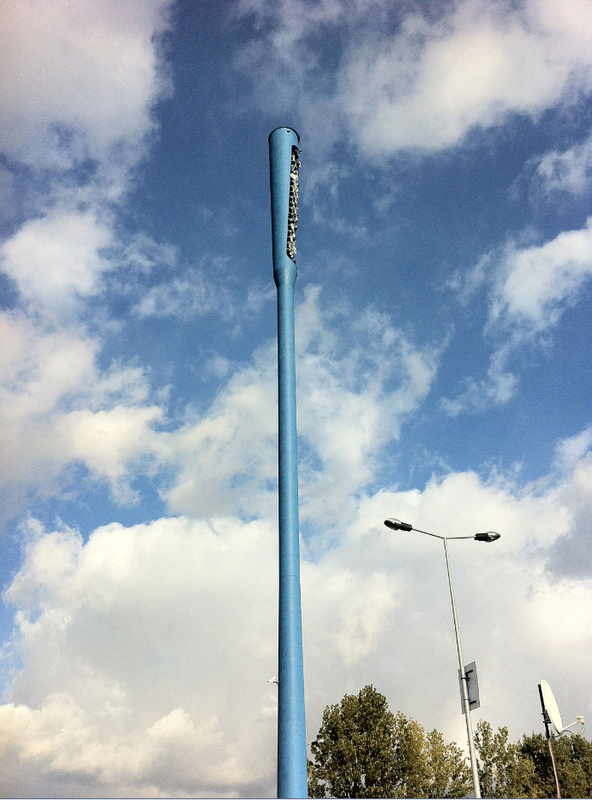
Tall, thin and blue Central European floodlight photo? Tick!

Fan cards are now a requirement in Poland for Ekstraklasa games. In a clampdown on hooliganism ahead of the Euro 2012 competition next summer, fans are now required to register their details with the club in order to buy tickets. When the supporter arrives at the stadium, they are then required to scan their cards to gain entry.


After leaving with our 5 Zloty ID cards and 25 Zloty tickets (a total of six quid for a top-flight game), a trip back to Katowice and their German-themed 'Bierhalle' restaurant for a couple of litres of beer and pretzel (at £3 a time) saw out the rest of the evening.

With no games on the agenda for Friday, sightseeing was the order of the day. An early start was required for a sobering trip to the nearby former Nazi Concentration Camp of Auschwitz, before heading back to Gorny Sląsk to visit two more of the local stadia.


Stadion GKS Katowice

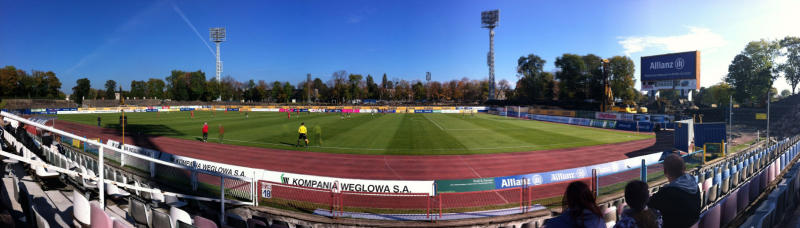
With time pressing on and darkness closing in, it was decided that GKS Katowice should be the first of the day's two grounds as the club shop closed at 5pm and everyone was keen to grab some souvenirs. After grabbing a yellow-and-black home shirt for myself, and a couple of green away jerseys for Gareth and Bridgie (as well as free GKS Katowice pens thrown in for good measure), a 30-minute walk through the Silesian Culture and Recreation Park brought us to the former home of the national team, the Stadion Sląski.

Before its redevelopment, the Sląski held over 50 Polish International games as well as numerous cup finals and European club games. During Manchester United's 1968 European Cup win, the Stadium hosted the Red Devils' Quarter Final with Gornik Zabrze. Over 90,000 crammed into the Sląski to see a Wlodzimierz Lubanski goal inflict Matt Busby's only defeat on the way to lifting the trophy.


Stadion Śląski

Now halfway through its redevelopment, the Sląski is already looking like an impressive structure. And if it wasn't for the late start of construction and the following numerous delays, there is no doubt it would have made an excellent Euro 2012 stadium. But even now, the mooted completion time of April looks unlikely. With the area still looking like a massive building site and the harsh Central European winter closing in, it looks like it'll be ready in the summer at the earliest. After pondering the stadium's purpose following the building of the new Narodowy Stadion in Warsaw, we headed back to sup a few jars of Tyskie and watch the Podbeskidzie - Cracovia game on TV; before calling it an early(ish) night.

Crack On, Krakow

Wisla Krakow 3-1 Jagiellonia Bialystok (15:10:2011)

Waking up at 7:30 to catch a bus to take a 70km bus ride is something that doesn't usually fill me with excitement. But when the destination is Krakow, and the reason for travelling is to see some Polish Ekstraklasa football, for some reason it makes it very easy.

Both of the top-flight clubs in Krakow, along with many other clubs in the country, have recently had massive stadium upgrades. Cracovia have redeveloped their decrepit old ground with a modern 16,000 seater which manages to put many Premier League grounds to shame; whilst the city's bigger club Wisla (although it's probably best not to say that out loud when walking through Rynek Glowny), have also rebuilt their home in the past few years. The Henryk Reyman Stadion has gotten rid of the old grass banks, and is now a stadium fit to host European football - and actually did, when Wisla played Fulham just 5 days later. And it was Wisla's home which was to be our first stop of the day, where we were to pick up our fan cards and tickets for that evening's game.


After parting with 25 Zloty for the match ticket, and 10 Zloty for the ID Card (£5 and £2 respectively), we were soon on our way across the city's Park Blonia to visit the second stadium of the day - the Stadion Cracovii, home of Wisla's arch-rivals Cracovia. And with a bar inside which looks out into the stadium, it would have been very rude of us not to take a goosey around.


Stadion Cracovii


A bite to eat and a few beverages overlooking Pasy's pitch later, and it was off for a short sightseeing trip in Krakow. We took in Wawel Castle, the Market Square, Hard Rock Café, and the very turgid Liverpool versus Man United game in the company of some Scouse/Polish fans who only were able to repeatedly churn out the "Steve Gerrard" chant in broken English. But after the final whistle, it was finally time to head back to the Henryk Reyman for the Ekstraklasa action which we were all craving.


Jagiellonia Bialystok were the visitors to Poland's second city and, after scanning our ID Cards and having the obligatory searches conducted, we arrived into our seats in time for a minute's silence for a Jagiellonia supporter who had fallen from a train whilst making the 250-mile trip from near to the Belarussian border. As a result, only 20-or-so Jaga fans had made it in time for the start.

When the game kicked off, it didn't take long for us to realise that earlier in the morning when we had asked the lovely young Polish lady in the ticket office for tickets "Away from the Ultras", allowing us to observe them and take photographs; she had quite clearly misunderstood and placed us smack in the middle of the C-Sektor - where Wisla's most vocal and active supporters reside.


 Wisla's C-Sektor

Cue a first half filled with plenty of action in the North Stand, whilst the football on the pitch failed to match the intensity of the support. Whilst the Wisla ultras sang in support of their friends at Lechia Gdansk and Sląsk Wroclaw, Israeli striker Dudu Biton came closest to breaking the deadlock, somehow firing over the Jagiellonia bar from just a few yards.

Obviously riled up by the quality of food available in the concourses at half-time (seriously Wisla, the wrap was soggy, the chicken bland - 2/10 at best), both sides came out of the blocks in the second half. And when 18-year old Jan Pawlowski slotted past Wisla keeper Sergei Pareiko, the Jagiellonia fans (who had swelled in size after the late arrival of the earlier mentioned train) were sent into raptures.

Although the home support never stopped chanting, they were keen to show their disappointment in the Wisla performance by performing a stadium-wide "Grecque" (It's not a fecking "Poznan"!!!) turning their backs to the game for 30 seconds; before turning to face the action and continuing to pound up and down. The Wisla fans were eventually rewarded with 10 minutes left, when the ball hit Dudu Biton on the leg and looped into the air. Dutch defender Kew Jailens then proceeded to challenge the Jagiellonia keeper in mid-air (some would say unfairly; the rest are either blind or Wisla fans), and the ball somehow was bundled into the net. Protests all around from the Jaga players fell on deaf ears, and eventually resulted in a yellow card being dished out to one defender. But all the Wisla supporters cared about was that the goal stood. One-all, game on...

Just seven minutes later, Lukasz Gargula's cross was met perfectly by the head of Andraz Kirm; and when the effort was saved superbly by Jagiellonia keeper Tomasz Ptak, Bulgarian substitute Tzvetan Genkov was on hand to rifle the ball into the net from 5 yards.

Before the Wisla faithful had even finished celebrating Genkov's strike, Slovenian midfielder Kirm received the ball 40-odd yards from goal and proceeded to smash the ball past the helpless Jagiellonia defence and into the bottom corner.

As the final whistle sounded in the Henryk Reyman Stadion, the crowds' singing continued. Ringing out the club's "anthem", the support patiently waited for the Wisla players to head in front of the C-Sektor before, at the top of their voices chanting "Jazda, Jazda, Jazda" (roughly translated as "Go, go, go"), to which the fans reply "Biala Gwiazda" ("White Star"). The sequence is then reversed, before the mad rush out of the ground begins.


 Wisla fans singing with the Players

With the Wisla scarf now tucked safely out of sight, our long walk to catch the last bus to Katowice proved difficult. It wasn't until the return home until the bruises from the red plastic seats were noticed, but the experience was definitely worth it.


Sląski, Bloody Sląski

"Trzy bilety do Gliwice proszę."

"Dziękuje."

With the majority of my Polish knowledge exhausted at Katowice Train Station (well, the stuff that's repeatable on these pages anyway), we were soon on our way to Gliwice; birthplace of - among others you've probably never heard of - Lukas Podolski, and home of I Liga club Piast. With a population of around 200,000 (maybe they had all buggered off when we popped in), the city is apparently twinned with Doncaster, although it doesn't seem to claim that out aloud.

Over the past year-or-so, Piast have been waiting for their new 10,500-capacity stadium to be built; and now finished, the club will move in to it over the next few weeks.


Stadion Piast


After a quick nosey around the exterior of the stadium (quick summary: it looks amazing considering it's made from Lego), we had half an hour to get to the neighbouring city of Zabrze in time for kick-off in our first game of the day. Our task was made even more difficult as we emerged onto the main road with no taxi in sight.

After a ten minute walk, five minute bus-ride back into Gliwice city centre, and a further 15-minute and ?16 taxi ride later, we finally entered Gornik Zabrze's Stadion Ernesta Pohla, just as the referee blew the starting whistle....

To be continued........


Ryan is the Editor of Modern Football and Los Revolucionarios