Showing posts with label Hertha BSC. Show all posts

Tuesday, 23 August 2011

1. FC Union Berlin & Hertha BSC Berlin


Everybody Needs Good Neighbours

FC Union Berlin 3-0 SC Paderborn (05:08:11)
Hertha Berlin 0-1 FC Nürnberg (06:08:11)

The t-shirts, beer cups and the signs on the numerous merchandise cabins dotted around Hertha Berlin’s Olympiastadion all bore the same slogan: One city. One club. One goal, writes Thomas Carding. Despite this boast, and as anyone present in the very same stadium during last season’s Berlin derby can testify, the Old Lady is starting to take note of her upstart eastern rivals. On a rare weekend when the German capital hosted both the Hertha and 1.FC Union Berlin, last year’s Derbysieger, the German capital showed it is far from a one-club city.

Already three games into a busy 2011/2012 season, spirits were low at Union Berlin’s Alte Försterei stadium on Friday night. After leaving Frankfurt with one fortuitous point in the season’s opener, a 0:4 home crushing by Fürth was followed by an early exit from the German Cup at the hands of fifth-tier Rot-Weiss Essen. Even the scoreboard seemed resigned to further disappointment, its ‘inspirational’ pre-game message a quotation from David Lloyd George: “The proof of heroism is not in winning a battle, but in bearing a defeat.”

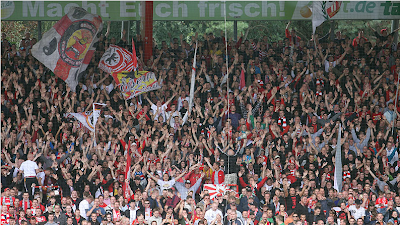
This hardly helped to stem the palpable air of tension in the Köpenick forest. The customary chant of Fußballgott! which normally greets the names of the starting line-up was noticeably quiet for certain new additions to the Union side. This time, the ritual was accompanied by a banner decreeing that the title of ‘Football God’ was one that must be earned. Another banner unfurled by the Ultras just before kick-off summed up the general mood among the Unioner more succinctly: Unzufrieden. Dissatisfied.

The power of the cult club’s fans, however, can also be a positive force. Hollering along to the club’s hymns, Stimmung in der Alten Försterei and Eisern Union, by East Berlin heroes Achim Mentzel and Nina Hagen respectively, and then taking over the mantle themselves after kick-off, the wall of sound they create almost seems to create another line of defence. When your goalkeeper is a month shy of his nineteenth birthday and playing his first ever professional football match, this is quite an asset. All told, young Kilian Pruschke, covering for the injured Marcel Höttecke and Jan Glinker, had little chance to distinguish himself during a quiet evening in front of the Union goal. Most of the action happened at the other end.

Eisern Union

‘Iron’ Union are a proper, proud, working-class club, with their roots in the East German trade union movement. Sometimes, the football their representatives on the pitch play can be appropriately straightforward, no-nonsense, traditional fare, all long hoofs, tough tackles and flying wingers. That Union’s first goal of the afternoon came from a set-piece does little to dispel this somewhat simplistic notion of Germany’s Stoke (that the Potters’ Robert Huth is a local boy who was plucked from Union Berlin’s youth set-up hardly helps). Christian Stuff, a strapping Berliner in the Huth mould, had found so much room in the box that as soon as the corner was kicked, you knew it was his to squander. A powerful header, beating the Paderborn keeper’s outstretched hand and hitting the back of the net, emphatically answered any momentary doubts that it could be quite so straightforward.

While the fans roared on, Union seemed to hold back a little, with promising wing play from young Christopher Quiring and fit-again Michael Parensen (nominally a defender), petering out upon reaching the Union strike force. Simon Terodde and Silvio, both promising against lesser opposition (and Hearts) in pre-season, have yet to really find their feet this season, and will have a lot to do to replace the confirmed deity Karim Benyamina, who left for FSV Frankfurt in the close season.

When Union’s lead was doubled in the second half, it was promising in terms of both source and execution. A long, but by no means aimless ball from Markus Karl set Quiring racing, with the helpless left-back no match for the twenty year old’s pace. The first touch deftly wrong-footed the keeper, the second slotted the ball home with a calmness that belied his years. A third goal, and euphoria, soon followed, Quiring netting his second after Paderborn’s keeper could only parry Silvio’s shot into his path.

Three goals up with nearly twenty-five minutes to go and facing little resistance, Union’s players were content to sweep the ball around, possibly trying to build up confidence in an amateur goalkeeper and a defence that had been decidedly porous of late. Within minutes, however, the cries of Olé had turned into whistles and shouts of ‘Pfui!’, as the pre-match tension once more bubbled to the surface. After three disappointing matches, the Union fans clearly weren’t ready to see the Berlin bear sit on its haunches and retract its claws so soon. This being German football, in particular Union Berlin, what the fans want goes. But while the tempo did pick up a little, with Quiring and Parensen subbed off, the boys from East Berlin did not offer much of a threat, and the 3:0 was a formality.

By the final whistle, all negative thoughts and pre-game doubts seemed to have been forgotten. Union, though, will find themselves up against much tougher opposition than Paderborn this year, and with the momentum of the resurgent Hansa Rostock and Dynamo Dresden (Union’s next opponents), and the constant threat of nearby Energie Cottbus, they don’t appear well-placed to become the next team from the former East Germany to crack the Bundesliga. There are, however, some reasons for optimism: the flashes of dynamic attacking football, the comfort with which Markus Karl seems to have stepped into Dominic Peitz’s shoes in the ‘number 6’ role in front of defence, and perhaps most obviously, the pool of young talent at their disposal, all mean their blue and white rivals at the far side of the city will eventually have to take notice.

Fast forward roughly 18 hours, and the mood outside the Olympiastadion matched the sunny weather. Basking in the afterglow of their successful season in Germany’s second league, which had brought instant promotion back to the Bundesliga, flags proudly proclaimed ‘Nie wieder 2.Liga!’ A hassle-free victory in the DFB-Pokal the previous weekend, also against fifth-tier opposition, had served to heighten expectations. Much of this is based on the young team Markus Babbel had moulded in the previous season, in particular the nineteen year old Pierre-Michel Lasogga, who in his first professional season scored thirteen goals and became a fan’s favourite and a regular starter. Goalkeeper Thomas Kraft, lured to the capital from Munich much to the chagrin of the Bayern fans, and his former teammate Andreas Ottl, both free transfers, seemed like shrewd and useful acquisitions.


The gateway to the Olympiastadion and the stadium's lawn, still watched over by statues of Aryan sportsmen.

To greet the Bundesliga season’s opener against FC Nürnberg (like the Premier League, the top-level in Germany starts later than the others), the Hertha Ultras in the Ostkurve had planned a spectacular piece of choreography. Timed to coincide with the players’ arrival on the pitch, and the singing of the Hertha hymn Nur nach Hause, this turned the entire end of the stadium into a giant blue and white sea, in front of which a momentous burly arm holding a flag was raised to the top of the stadium with on ropes.

That, sadly, was the most exciting thing to happen inside the Olympiastadion that day. Indeed, the ‘highlights’ collection of the first half later offered on Sky featured, after the said choreography, some choice pitchside advice from a Hertha-supporting actor (‘Just try and remember to breathe. Breathing is always important.’), a 31st minute incident in which the linesman was hit in the face with a ball, and then a collection of fouls. And no actual play whatsoever.


The main diversion early in the second half was the incredible and bewildering level of hatred shown towards FCN’s keeper Raphael Schäfer, an ear-piercing medley of Pfuis and whistles and even an effigy hanging from a makeshift cross. It wasn’t until almost fifty minutes into the game that Nürnberg, the more dominant side throughout, had a half-chance, and even then, it was a tame header from the edge of the box. Kraft, presumably for want of something to do, positively leapt onto the ball.

By the mid-second half, attention was beginning to wander from the game and discussion in certain sections was turning to the curious nature of fan-friendships in German football, possible reasons for the abuse Schäfer was receiving, and a planned trip to wander over to the Le Corbusier skyscraper adjoining the Olympic park after the match. Lasogga and Ramos, who had gobbled up goals in the 2.Liga, went hungry here, with barely even scraps to feed on from a tight opposition defence and a home midfield entirely devoid of ideas. Ottl broke up the play well, but then did not seem to know what to do with the ball. Hertha seemed to be missing a creative spark, but the Brazilian Raffael, relegated to the bench after disciplinary issues, looked disinterested when he was finally introduced.


The Nürnberg fan block

Meanwhile, Nürnberg were starting to awaken and threaten even more. Positive substitutions, with striker Alexander Esswein heading wide in a 4-3-3, and Jens Hegeler offering a link from midfield, eventually brought the breakthrough. Hegeler pulled back a cross from the goalline, and Czech international striker Thomas Pekhart, formerly of Tottenham, ghosted in at the front post to secure a neat debut goal. The final result of 0:1 was perhaps what Hertha deserved for an unadventurous and uninspired display.

It was a rude awakening for a team dreaming of a ‘rightful’ place in the Bundesliga and perhaps harbouring hopes of European football. Nürnberg, a team who finished 6th last season, were never going to be a walkover. If, though, such a powerful and positive atmosphere cannot spur the players into life, they may struggle come squeaky-bum time, and a Hauptstadt-Derby next season could still be a possibility.

Union’s game on the Friday night had been a tale of clinical victory assuaging a fair amount of angst and tension. Conversely, Hertha’s was a case of a drab performance turning a festival atmosphere sour. So sour, in fact, that it led to nineteen arrests. Incidentally, a little post-game research reveals that the abuse directed at Schäfer related to a rude gesture he had met the last time the two sides met. Like the excited build up before the paint-dries-faster game, it seems in hindsight like a lot of fuss over very little.

So early into the season for both teams it is hard to speculate as to where Berlin will be on next season’s footballing map. What is for certain is that Hertha should ignore their noisy neighbours at their peril – or they could find themselves embarrassed by their city neighbours all over again.

You can follow both Tom and European Football Weekends on Twitter

Discuss this and more on the new EFW Forum

Monday, 7 February 2011

Hertha Berlin v Union Berlin


Union City Blues

Hertha Berlin 1-2 FC Union Berlin (05:02:11)

74,244 fans; two teams; one city. In terms of football matches, those ingredients are normally a recipe for hatred and evil. But this was meant to be different. I was told that here, fans would stand, drink and sing together, apparently. This was going to be the biggest party in these parts since man of peace, David 'The Hoff' Hasselhoff stopped talking to a car, stood atop a party-demolished wall and belted out a note perfect rendition of Looking For Freedom to several hundred thousand people. Welcome to the Berlin derby.

After getting up at silly o'clock (hello to you 4am), and taking the short flight to Germany, Big Deaks and I met up with my Qatar Hero, the mighty Stoffers, Abby, some Polish lads, and Damon from the Real FA Cup. Our pre-arranged meeting place was also the venue for the majority of FC Union fans to gather before the match. The first fire cracker was let off just after 10am at the Alexanderplatz Station. That woke us up.

Our €16 match ticket was good for all public transport in Berlin from the moment we landed until the time we called it a day on the post match beers - twelve hours after the game. That is the way to do it.

The trains were obviously packed, but we squeezed on one and pitched up at a pub next to the stadium. At the bar and getting in a round of beers was none other than, self proclaimed red-headed "sexual icon" Mick Hucknall from Simply Red. Buying some Berliner Kindl Mick? I thought money was too tight to mention. He certainly wasn't holding back the beers.


20000 away fans start to arrive. 


Only in Germany.


Seven turnstiles + 20000 away fans = a little bit of a queue to get in. 


Fancy dress was the order of the day for the police. 


German efficiency wasn't perhaps quite what it should have been in and around the Olympic Stadium. There was just seven turnstiles to cope with 20,000 (20,000!) away fans and the queues were enormous. Once inside, you had to negotiate your way past a corridor full of riot police dressed up as stormtroopers and then try and find your seat. Easier said that done that. All the ultras had pushed their way down to the front and the gangways were jam-packed with fans. The only access out was via an 8 foot drop over a wall. Good job I hadn't downed as many pre-match beers as Hucknall. Any sort of visit to the latrines was virtually impossible.

We sighed when Hertha took the lead with the helping foot of Christian Stuff who bodged an attempted clearance straight into the path of Andre Mijatovic. He then chipped an inch perfect pass to Roman Hubnick who nodded Die Alte Dame (The Old Lady) into the lead with his noggin. It looked at that stage that Hertha were going to run riot and notch up a routine victory.

Against all logic and reason, FC Union then turned the game on its head providing plenty of fight and spunk. First to rip up the form book was John Jairo Mosquera who controlled the ball with his arm (whoops) before lashing an unstoppable volley in the top corner. The Union fans celebrated by letting off a whole bunch of flares. This is what I'd come to see. Granted, I had to cuddle about six different strangers in the stands during the celebration, but the place was absolutely rocking. Fan-favourite Torsten Mattuschka's scored the winner with a  wicked free kicked that bounced over the keeper. Scenes of unbridled joy filled our end of the stadium. The ultras used a seasons worth of flares in one game. They probably hadn't banked on using more than one, but this was worth it.


What's the time? It's flares o'clock.


Hats the way to do it.


Union City Blues.

In my experience, they couldn't give a rats arse about anything in German football grounds aside from singing their hearts out and necking as much beer as is humanly possible. And that's just the stewards. Not today though. Normally, they sell Carlsberg inside the Olympic Stadium - not the bland, watery UK stuff, but the proper Danish version - in handy litre mugs. For this game, all that was on offer was non-alcoholic beer. Probably a good job. The match kicked off at 1pm and there was an eleven hour pub crawl around the Eastern parts of Prenzlauer Berg and Friedridchshain on our agenda for the evening.

There was no trouble at the match. At one stage the Hertha ultras produced a banner declaring "Football culture takes its path. Your cult is for sale as well" to annoy the Union fans, but it didn't work. It was a reply to Union's train tifo in the previous derby between these two. Union remains one of the most non-commercial, old fashioned and authentic clubs in Europe though, so they just laughed off Hertha's banner and carried on celebrating.


For sale: Your cult. 


The game passed off peacefully and the 3248 police riot vans probably weren't required.

This match had the feel of an old Merseyside derby - before that particular game became a bit sinister. Fans did sit side-by-side, and without a hint of any animosity. Fans of both sides partied long and hard after the game. Next weekend, Union's Under 23 side play against Dynamo Berlin. That's a full on rivalry and predictions of trouble at that match are very real. This may be first and last time Hertha take on Union during a regular season as their paths aren't likely to cross again with the Blue-Whites set for promotion. I'm glad I was there though. There was some talk of the match being a fix afterwards. Absolute nonsense. Nobody will forget the score though. Not least because 24 hours later, "FCU 1-2" graffiti was already popping up all over Berlin. There is power in the Union. Prost!


FCU 1-2. Time to party.


The players didn't want to leave. They milked the celebrations for about 30 minutes. And. Why. Not.

For lots more photos from the day CLICK ME.

Like this? Then you might like Lok Leipzig v Sachsen Leipzig which we went to the next day.

- Feel free to comment below -

Wednesday, 26 January 2011

Hertha Berlin v Union Berlin

The derby with no history?

In a weeks time European Football Weekends will join 75,000 fans in the Olympiastadion to watch Hertha take on Union in the Berlin derby. David Tunnicliffe, an Englishman living in Germany, gives us the heads up on the history, or lack of it, between these two great teams.....

As Die Welt put it in September last year in the run up to the first ever competitive meeting between Union Berlin and Hertha Berlin, this is a “derby with no history”. To wrap it up in a sentence, it's all to do with where the two clubs are from: Union Berlin are based in the district of Köpenick which was formerly a part of East Berlin, capital city of the German Democratic Republic whilst Hertha originate from Charlottenburg in the north-west of the city and were a part of West Berlin and therefore West Germany.

When you think of city derbies you immediately think of pure hatred, passion, constant oneupmanship, but in Berlin everything was different. During the times of a divided Germany, East Germans were, of course, not permitted to travel to the West unless under special circumstances. The same did not apply the other way round, however, and it was often the case that Hertha BSC fans would make the journey over to Köpenick to watch Union Berlin matches or they would travel to away games elsewhere in the GDR together. Union fans would also accompany their Hertha counterparts if Hertha played a European match somewhere where the dear old SED ruling party actually them allowed to travel (in other words, anywhere east of the Iron Curtain). When Germany was reunited in 1990, the teams even played a friendly in the Olympiastadion which attracted over 50,000 spectators. The fans stood together, drank together and sung together. Further friendlies followed through the 90s, followed by regular matches for Union against Hertha's amateur team throughout the 2000s as the former meandered their way through the 3rd, 4th and even 5th tiers trying to avoid going bust. Perhaps Union Berlin's most famous and memorable match at the Olympiastadion did not even involve Hertha: On 26th May 2001, they contested the final of the DFB-Pokal as a third tier team against Schalke 04, losing 2-0.


As the respective country's leagues developed in the late 50s and 60s, the Bundesliga in the West and the Oberliga in the East, rivalries obviously developed at the same time. Ask 99% of Union Berlin fans who they believe their arch-rivals are and they'll say BFC Dynamo, or Dynamo Berlin as they are more commonly known. This rivalry developed from the fact that Erich Mielke, the then Minister for State Security (or Head of the Stasi) happened to be a BFC fan and 'helped' them along the way to 10 GDR Oberliga titles in row between 1979-1988, which was a record. BFC are now in the 5th tier and this season are enjoying a couple of 'derbies' against Union's reserve team. As for Hertha's rivals, being 200km from the rest of the country was certainly not conducive to the development of any territorial rivalries during the GDR/FRG times. There is a strong dislike of Schalke 04 dating back to the 70s, although no-one really knows why. Some say it's because Hertha were forcibly relegated from the Bundesliga in 1964/65 for cash payments and illegal bonuses whereas Schalke were allowed to remain in the division after committing the same crime in 1971. They do have a fan friendship (something which is kind of difficult for an English football fan to understand, I must admit) with Karlsruher SC resulting in games between the two being some kind of mass singalong love-in.

In more recent times, the Union and Hertha had not really considered the thought of playing seeing as Hertha had been Bundesliga stalwarts since the mid-90s with a succession of top-ten finishes whilst Union flirted between the 2. Bundesliga, the third-tier and the fourth tier during the same period. Even when Hertha had financial troubles (something they have still not shaken off) in the early 90s and went down, Union were nowhere to be seen and as Union took home the inaugural 3. Liga title in 2008/09, that was the season Hertha were battling for the title and only missed out on Champions League qualification on the final day of the season. For Hertha, the following season was a nightmare. They quickly sank to the bottom of the Bundesliga and stayed there for the rest of the season. Once Union secured their 2. Bundesliga status with a 3:0 victory over Arminia Bielefeld with a couple of games to spare, the fans could really start looking forward to “the derby with no history”.


In June the fixtures were released and the matchday was set for the first 'true' Berlin derby in 60 years and the first competitive fixture between the two in a national league. The game would take place on the weekend of 18th /19th September and Union advertised season tickets with the slogan “The only way to guarantee a ticket for the derby”. In fact, I know of Hertha BSC fans who bought season tickets at Union Berlin just to be sure of a ticket for this match. It was surely going to be a sell-out and the Union board knew this. There were rumours of the game being switched to the Olympiastadion, something which would have netted Union an estimated additional € 1m in gate receipts. Fans were understandably not happy. The first reason was purely that they would be sacrificing home advantage for the sake of business and the second was that it was the fans themselves who had voluntarily devoted over 16,000 working hours during the 2008/2009 season to completely redevelop the aging Alte Försterei stadium in order to make it fit for a second division side. Sure enough, during a pre-season friendly, it was announced that the game would take place in Köpenick.

The build up to the match was intense to say the least. It was almost as if the first three games of the season didn't count – this was the big one. Indeed Union probably wished the first three indeed hadn't counted, as they lost 2 and drew 1. Hertha had won all 3 and were joint top but, despite the form coming into the match, a cracking match finished honours even. The Ultras of both groups of fans both put on impressive displays, with the Hertha fans unveiling a banner echoing the words of Ernst Reuter, mayor of Berlin at the time of the Soviet blockade after the Second World War, roughly translated as “People of the world, look at this city”. Union fans played on the reputation of there being a rather large “prawn sandwich brigade” in the Olympiastadion on match days with an impressive choreography showing a man trying to make a decision about which S-Bahn train to get on as two of them arrived at a station, one towards Köpernick and one towards Charlottenburg . The banner read “Football culture shall take its course. What train do you get on?”. On the Hertha train, the fans were portrayed as corporate 'customers' (e.g. with vuvuzuelas) whereas the fans on the Union train were portrayed as true football supporters.


“Football culture shall take its course. What train do you get on?”


“People of the world, look at this city”

Since the first meeting between the two, Union have improved slightly. They won their first away game for more than a year away at probably-already-relegated Arminia Bielefeld (a result which cost former Tottenham 'legend' Christian Ziege his job at Bielefeld) and picked up points at home against teams like Aachen and Karlsruhe. They lie 12th in the 18-team 2. Bundesliga and are only 5 points above the relegation playoff place. Hertha, on the other hand, have remained at the top of the league, despite four defeats in five in November and early December. Promotion this season is key for them. They were almost denied a licence to play in the 2. Bundesliga at the start of the season due to their financial situation. The city senate decided to defer the payment of stadium rent for a season, something which has also heated up the atmosphere between them and Union, with the latter believing that the taxpayer has granted Hertha an unfair advantage. With this being the derby with no history, you can't help but think it's being created right now.


Fans of FC Union are meeting three hours before kick off at the Alexanderplatz.

Like this? You might like The Leipzig Derby.

- Who to support? Feel free to comment below -