Showing posts with label Football in Bosnia and Herzegovina. Show all posts

Friday, 7 October 2011

FK Željezničar v Sloboda Tuzla


The Railway Children

FK Željezničar  4-0 Sloboda Tuzla (02:10:11)

Bosnia isn’t a country which has much positive associated with it – war, tragedy and death seem to be the ideas most people seem to associate it with, writes James Doe.

The conflict which wreaked havoc in the country between 1992-95 was an awful chapter in  the region’s history and should never be forgotten but it ended 16 years ago and apart from a pretty dire political stalemate (the country is effectively divided in two between Muslims and Croats on one side and Serbs on the other) it is now a largely safe, cheap and very enjoyable place to visit.

A trip to Bosnia has been on my list for several years but I’d never quite got round to it so with a bit of time and some post-BBC redundancy money, my wife and I finally booked the flights and headed off.

Sarajevo is unlike any European capital city I have visited. Its architecture is a real mixture of Ottoman, Viennese and Communist styles. Many buildings bear the scars of the relentless shelling of the recent conflict but this only adds to its character. To top it all, it is surrounded by towering mountains which make for some breathtaking views.


The heart of the old town

Having spent a week seeing the sights of Sarajevo and also visiting Srebrenica, Mostar and Travnik we decided to spend the last night of our trip at the 12,000 capacity Grbavica Stadium watching FK Željezničar host Sloboda Tuzla.

Formed in 1921, the ‘Railwaymen’ are one of two big clubs in town (there are other smaller ones too) and are located south of the river whilst rivals FK Sarajevo occupy the former 1984 Winter Olympic Stadium on the north side.

The last couple of years have been pretty successful for Željo having won the Bosnian Premier League (2009/10) and Bosnian Cup (2010/11) and after a slightly indifferent start to this campaign, a run of four straight wins in the league and cup saw them come into this game in good form.

Sloboda, by comparison, are an older club (1919) but have a much more modest record and have yet to win any domestic honours. Having lost the majority of their games this season, it looked like this was set to continue.

Fuelled up on the local delicacy ‘Ćevapi’ (a kebab-style dish consisting of bread stuffed with around 10 small beef sausages), getting to the Grbavica neighbourhood from the main tourist area was easy with the tram dropping us off a short walk from the ground.


Cevapi dish (altogether now .... what's not to like? - Ed.)

The buildings on the approach to it are mainly residential blocks which appear to have received a lot of attention from the Bosnian Serb artillery during the war. Being close to the front line, the stadium itself took a lot of punishment too with the wooden terraces being burned but there’s little evidence of it now.

On arrival at the ground, there was no obvious sign of a ticket office. After getting the information from a steward (and nearly poking out a supporters’ eye as I swung my arm out to verify my instructions – a heartstopping moment), I made for a hut at the intersection of the North and West stands.

Despite my lack of Bosnian and anything like the correct change, I managed to get two tickets for the North Stand behind the goal with relative ease and for a total of just 16 marks (£7).

Having timed our run to the ground pretty late, most of the good seats had already gone. Not wanting to stand out too much as tourists we swiftly made our way down to the front only to find virtually every seat was covered in bird droppings.


Seeeeagulls

Željo fans in the North Stand (i.e. not ultras) are often referred to as the ‘seed eaters’ because they often munch through loads of them as they watch the game – afterwards the birds fly in for the leftovers and leave a little something behind themselves. Finding seats with minimal soiling we sat down and hoped for the best.

The game got under way at sunset to the sound of the Islamic call to prayer from a nearby mosque but apart from that there was little noise. Whether this was out of respect (Sarajevo’s population is estimated to be 70-80% Muslim) or the fans were just slow to get going was unclear. The lack of any obvious away support also ensured the atmosphere took time to develop. However, after a couple of minutes ‘The Maniacs’ (Željo’s ultras) started to crank things up in the South Stand and remained in fine voice for much of the game.

As a contest the game was very one sided with the hosts racing into a 4-0 half-time lead with goals from Vernes Selimović, Zajko Zeba and a brace from Eldin Adilović that would have made former player Edin Džeko proud.


Apprentice 'Maniacs' 

With their team easing off in the final stages and no more goals materialising, it was notable how many of the home fans left early. With the best part of 15 minutes to go, significant numbers began making their way out which is something I’ve never seen from supporters of a team winning so handsomely.

On the final whistle, the wife and I turned round to find a sea of empty seats covered in trouser-protective newspaper as our efforts to blend in as regulars had clearly failed miserably. Consequently we waited for most people to leave before gingerly rising to inspect our clothes - fortunately they hadn’t suffered too much.

The crowd was officially listed as 4,500 so the queues for trams were short and the journey home was straightforward.


Union City Blues

Overall, a visit to Sarajevo is one I would heartily recommend. I had always been very wary of going to a match in the Balkans given the reputations of some of the fans in the region but this was a totally trouble-free experience.

The fact that the clubs we saw both came from largely Muslim areas of the country probably had something to do with that – when a Bosnian Serb team come to visit then expect the atmosphere to be less cordial.

The city’s derby is supposed to be a great match to attend with the relationship between Sarajevo and Željezničar said to be similar to that of Everton and Liverpool. This season’s matches are in November and May so go if you get the chance.

The only drawback to spending a European football weekend in Sarajevo is the fact that there are no direct flights from the UK. To my knowledge, GermanWings are the only budget operator to currently connect the two destinations while a number of national airlines will also do the job (we went with Austrian Airlines). Whichever you choose, it can be done in around four hours which isn’t too bad.

Also, don’t let the fact that this is a largely Muslim city put you off. Although there are religious people here, they are in the minority and their approach to Islam is very different to the more conservative areas in certain parts of the Middle East and Asia. Although there isn’t a big drinking culture here, alcohol is readily available in restaurants and bars.

One final tip - I received a lot of very helpful information about going to this match from a young man called Skender who runs tours around Sarajevo and Bosnia. Get in touch with him if you have any questions about watching football here, he’ll be very pleased to help you (http://www.sarajevofunkytours.com/en/contact-and-location.html).


James is the brainchild behind the tremendous Non-League Day initiative.

Tuesday, 5 April 2011

Nick Ames in Bosnia & Herzegovina


Pjanjic at the BiH FA

Bosnia & Herzegovina 2-1 Romania (26:03:11)
Celik Zenica 1-0 Olimpik Sarajevo (30:03:11)

Possibly not for the first time, the wishes of UEFA and FIFA differ to that of another organising body. Nick Ames explains why they're in conflict with some Bosnia & Herzegovina FA delegates, and enjoys a couple of football matches into the bargain...

Widened hands at the ready, the local media prepare to applaud Safet Susic into the press conference room. He deserves it – not especially known for gamechanging from the sideline, his second-half sleights of hand have stirred up the momentum to finally see off an insipid Romania at Bilino Polje and give Bosnia & Herzegovina (BiH) a fighting chance of achieving what they couldn’t quite manage in the last qualification tournament they entered.

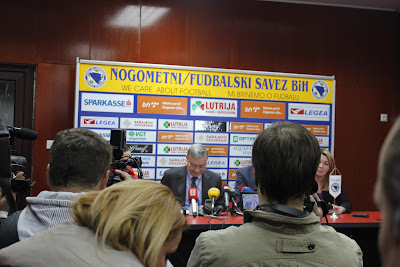
The door swings open, but Susic isn’t there – not yet. Mircea Sandu, the Romanian representative on UEFA’s executive committee, sits down in front of a surprised press pack, all gleaming grey hair and fixed bonhomie. The cordial oozing of imminent danger chimes of dinner with a Bond villain. A harsher light is immediately set upon the chaotic celebrations that had taken place not half an hour previously. Sandu congratulates BiH on their deserved win against the nation he represented 18 times. He wishes them the very best of fortune in their qualifying campaign, and wills that this extends to the wider health of football in the country. However, he dearly hopes that the FA will shortly agree to align with UEFA and FIFA’s statutes on leadership in order that it avoids the international suspension that would otherwise be likely. It would be a shame if the national side’s progress counted for nothing, wouldn’t it, and that the two teams couldn’t meet again later in the year? He ups, leaves, mindful of the impact his speech has had on a room hitherto filled with positive potential energy. Susic finally takes his place, even though you half expect him to fall into a piranha-infested pool en route. The mood lightens again, even if analysis of the game itself has been set into discomfiting context.


Bond villain Sandu addresses the press pack

Forty-five minutes before kick-off, Bilino Polje had been packed to the rafters. You forget that things can still be like this in Europe; you consider genuine pre-match spectacles no longer to be within your reach or even your ken. The tannoy had been leading with the usual selection of rousing local anthems for a good hour prior, too, but suddenly it had stopped and – to a man – the crowd behind the left-sided goal had raised arms and flags in the air and begun chanting loudly, angrily. “Is it about the FA?” I ask Sasa, sitting beside me. “Yes, the FA”, he replies. “They’re calling for them to stand down, to change and let BiH play football. If they don’t, it might be game over.”

What a time to walk headlong into such a chaotic, bewildering narrative. Earlier that morning, Sarajevo had been sunny – waking up slowly, as it does, to the sound of pigeons and mosques and chatter over thick coffee. Slowly, flags would be unfurled and draped outside bars, flatscreen televisions being brought out to join them. Men wearing full national team tracksuits would take up position by racks of knock-off Manchester City shirts. Football-themed flags, and even pens, would be hawked all along Ferhadija. There’s a game on, that much soon becomes apparent, but it won’t be here. Sasa picks me up just after lunch, his brother and tracksuit-clad father in tow. They’ve come from Mostar but we’re heading to Zenica – located in a deeply working-class region 90 minutes north, it fashions itself as Bosnia’s Steel City and its aesthetics are accordingly uncompromising. Bilino Polje only seats around 15,000 but the atmosphere engendered by the locals, as well as the lack of a running track around the pitch, draws favour from the powers that be – the national team rarely loses there, the location’s intensity almost certainly being a decisive factor.


The local shopkeepers were feeling shirty

In the car, I swot up. The situation cuts two ways: BiH need to defeat Romania to put genuine pressure on Belarus for second place in their Euro 2012 group and to all but see off Razvan Lucescu’s men. After that, they need to defeat themselves. In three days’ time, the FA will vote to decide whether to replace their current leadership – an ethnic Bosnian, Serb and Croat triumvirate – with a single figurehead in line with FIFA’s stipulation. Opt against, and their current stay of execution will expire. The international ban will kick in for clubs and, probably, country from April 1 and the consequences could be wider ranging – and more damaging - than this column will allow.

Outside Bilino Polje, which is certainly the most ‘English’ of Bosnia’s stadia, everyone’s up for the first of these battles. Several hundred fans, all wearing dark blue hoodies bearing the legend ‘Hardcore Bosnians On Tour’ make a dramatic, synchronised march towards the ground. It’s peaceful, but inside the stadium they’ll have a fenced-off corner all to themselves. The navy mass will, placed opposite the open end full of colour and vim, look a brooding and sinister presence. It has its own repertoire of chants and flares, and will prove a curious sideshow for the entire evening.


Hardcore Bosnians On Tour

We have coffee outside the ground, exchanging stories and observations. A who’s who of Bosnian football seeps past – a Velez Mostar captain here, a Celik Zenica chairman there – all mixed in among the support. There don’t really seem to be any divides, any social strata, once you’re here. The sense of common cause, of pride in what is still a new nation, is strong.

BiH, already welcomed ear-splittingly when Emir Spahic leds his side out to warm up, begin the game to noise befitting a support of five times the volume. The relentlessness is stirring, quite special, and mirrored by Susic’s side, which begins at remarkable pace. Edin Dzeko and Vedad Ibisevic work the channels tirelessly, Miralem Pjanjic and Zvezdjan Misimovic cutting in from wide to infiltrate the spaces they vacate. It’s a whirlwind of activity but, save for a Misimovic effort that fools one side of the stadium into a celebration and a Dzeko shot that’s pushed away, the unambitious Romanians survive without too many close scrapes.
Then, naturally, the visitors score. Ciprian Marica, playing just ahead of Adrian Mutu, chests down a deflected Razvan Rat cross and volleys home sharply. It’s undeserved, but impressive – and the small pocket of Romanian fans celebrate in the far corner with flares and bared backsides, to the chagrin of the grim mass of navy blue on the other side of the goal. The hosts’ fire is dampened; a Pjanjic free-kick is well saved, but the rest of the first half passes in a fug of rotational Romanian fouling and misplaced Bosnian passes. This may be, but the Zenica faithful are yet to quieten down for a second.

Despite their lead, Romania have shown no ability to retain possession and little genuine evidence that they won’t crack under coherent attack. But they’ve just started to gain a small grip on the second half, with Gabriel Torje showing flickers to suggest his rising stature, when Misimovic swings in a free-kick and – not for the last time in the evening – their defence stands rooted. Ibisevic is not the only Bosnian primed for a free header, but he makes the ball ahead of Dzeko and glances into the far corner. Bilino Polje erupts, but the ball is spirited quickly back to the centre circle.


Misimovic sets up the equaliser 

Misimovic and Pjanjic might be compelling to watch, but in this system they’ve been problematic. Their drifting inside together has made Bosnia’s play very narrow, and neither quite has the burst beyond the last defender that would offset the issue. Susic makes a flurry of changes; Dzeko becomes the sole striker, with Pjanjic stationed behind him. Eventually, locally-based Darko Maletic will take up a right-wing perch and Senijad Ibricic will be stationed on the left. Zlatan Muslimovic joins Dzeko for the last ten minutes. Now BiH seem to have far more space, Pjanjic spreading the play hither and thither, and they use it at speed. Chances come and go; a goal looks inevitable, not least because a pallid and passive Romania haven’t looked interested in coming out despite the equaliser. Then it arrives. Pjanjic has a shot tipped over and takes the corner himself. It’s deflected, but not too sharply. Costel Pantelimon paws the ball lamely, hopelessly, into the air while five of his defenders fail to move a muscle. Two Bosnians are on the move, though, and this time Dzeko does get there first – it’s 2-1, and the press box goes as wild as any other corner of Bilino Polje. It finishes that way. Susic’s changes, and the momentum created by the equaliser, had made for a final half-hour as heady as anything I had laid eyes on for some time.


Dzeko's winner sends the crowd (and press box) wild

Two and a half days pass. I’ve been walking around Mostar for several hours, and now I’m striding through a neatly-appointed garden and an open, orange gate into Bijeli Brijeg Stadium. Nobody bats an eyelid as I walk round Zrijnski Mostar’s pitch and up into the gods of the main – and only - tribune, reflecting upon the strange history of a ground that played host to Velez Mostar’s finest hours in the 1970s before their Herzegovinan Croat rivals reformed and made it theirs. I’m closing in on one of the best panoramas you’ll get from the top row of a stadium when I receive a text message. Of 54 delegates in the BiH FA, 28 have voted against meeting FIFA’s wishes. Barring an unlikely about-face, the international ban will come into effect three days hence. I look at the careworn, graffiti-laced concrete around me and think that, for the one-time owners of this place, the 1975 UEFA Cup quarter-finals seem even further away than ever.


Panorama from the top row of the Bijeli Brijeg Stadium

It doesn’t deter me from returning to Zenica the following day. Bilino Polje is nowhere near as packed for Celik Zenica v Olimpik Sarajevo, but the crowd is still decent enough for the first leg of a cup semi-final. If the FA does not resolve its issues with FIFA and UEFA, the winners of this tournament will miss out on the benefits of next season’s Europa League – “nothing but a disaster; clubs will be destroyed”, a fellow onlooker tells me. Celik win 1-0, the industrial city’s support once more surpassing itself. There isn’t a single away fan; Olimpik have only been up and running since 1993 and are yet to gain a real foothold in the consciousness. The football itself spits and flickers; home left-back Emir Kuduzovic is the most impressive performer and lashes in the only goal, while promising young colleague Adin Dzafic, operating in an attacking left-sided position, shows some turns and touches that rise above the rest. It’d take a dedicated scout to be here. European football is one of the few ways in which a player from the Bosnian league can announce himself to any kind of broader audience; the sporting and economic consequences of being denied it go hand on hand with the talented professionals’ prospects of upward mobility.


Celik Zenica v Olimpik Sarajevo

Before leaving for London the next day, I read some newspapers. Pjanjic and other national team players haven’t held back – the FA are accused, from all corners, of betraying the country and its sport. It’s impossible to disagree, although it’s equally difficult to be fully aware of the far deeper-running motivations and fears that run behind the association’s need to divide power this way. Watching Susic’s richly gifted, if flawed, side it’s strange to conceive that the events in Zenica might all have been played out for very little. You suspect some kind of resolution will eventually be found, and deeply hope so; anyone who’s been to Bilino Polje will tell you that extraordinary places like this have to remain as relevant as ever.

Big thanks to Bosnian journalist Sasa Ibrulj for his help, and his company over beer, during my European Football Week (?) in BiH. Please follow him on Twitter - @sasaibrulj


You can also follow both Nick Ames and European Football Weekends on Twitter

Like this? Nick has also covered CFR Cluj for EFW.

Nick is a writer for Arsenal FC. He has his own blog: Last Seat on the Plane.

- Feel free to comment below -